The Comp Card That Books in Japan: A Foreign Talent's Guide
What Japanese casting actually looks at on your comp card and in your portfolio, the Japan-specific must-haves, and how to build a card that books instead of one that gets set aside.
Your comp card and portfolio are the first things a Japanese casting team sees. Often they are the only things. Long before anyone meets you, a producer is scrolling through a folder of cards, deciding in a second or two whether you fit the job. That second is what you are designing for.
The good news: a comp card that books in Japan is not mysterious, and it does not require a huge budget or a hundred images. It requires the right images, the right information, and a few Japan-specific details that foreign talent often miss. This guide walks through what casting actually looks at, what Japan expects, and how to build a card and book that work for you instead of against you.
First, the vocabulary
In Japan, the card itself is called a comp card — konpojitto (コンポジット), usually shortened to konpoji (コンポジ). You will also hear set card or sed card for the same thing. The broader profile photo used at the document-screening stage (書類選考, shorui senkou) is the 宣材写真 (senzai shashin), or promotional photo. When a casting director asks for your "comp," they mean the single card. When they ask for your 宣材, they may mean a cleaner single headshot or full-length used to screen on paper.
Knowing the words signals that you have done your homework, and in Japan that quietly counts.
What a comp card is for
Think of the comp card as a one-page sales sheet. It has to do three jobs at once:
- Show your range — not just one beautiful photo, but the span of looks you can deliver.
- State the facts — your measurements, in centimetres, accurately.
- Be easy to contact — your name and your agency's details, legible at a glance.
Casting teams in Japan often work fast and across many candidates. A card that makes them squint, or that hides your real proportions, gets set aside. A card that answers their questions before they ask gets a callback.
The layout Japan expects
The convention is simple and worth following:
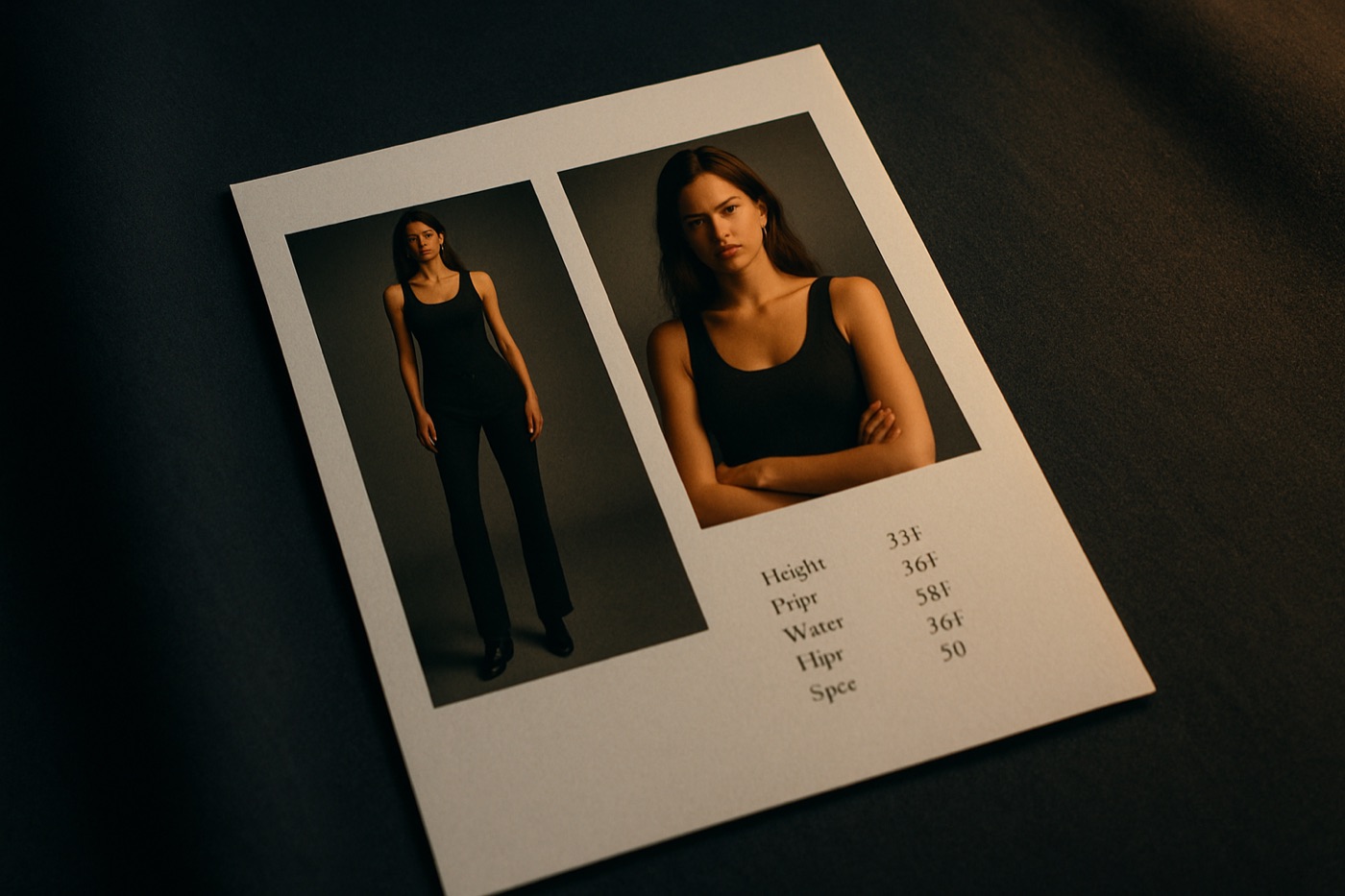
Front: one strong, clear hero portrait, plus your name. This is the image that has to stop the scroll. It should look like you on a good, normal day, not a heavily styled fantasy version that you cannot reproduce on set.
Back: three to five varied shots. At minimum, casting wants to see:
- A clear bust-up (face and shoulders, good light, minimal styling).
- A full full-body shot showing your real proportions head to toe.
- A few different looks — a smile and a neutral, a clean commercial look and something with more edge, perhaps one in motion.
Here is the Japan-specific point foreign talent most often get wrong: Japan wants both a clean bust-up AND a full-body, every time. In some markets a card can lean on editorial mood and atmosphere. Japanese commercial casting is more practical. They need to confirm your face reads well and see exactly how you are built, because so much of the work is catalogue, e-commerce, fitting, and commercial. If your card is all glamour and no honest full-length, you have made their decision harder, and they will move on.
Casting is not looking for the most beautiful card. They are looking for the card that answers their questions fastest.
The stats — and why centimetres matter
In Japan, your measurements go on the card in centimetres, full stop. Convert everything. A card listing feet and inches reads as foreign and makes the team do mental math they do not have time for.
For women, the expected stats are height and the three sizes — suri saizu (スリーサイズ), meaning bust, waist, and hip — plus shoe size. For men, it is height, chest, waist, and inseam, plus shoe size. Then, for everyone: eye colour, hair colour, nationality, and your agency's contact.
Two things matter more than they sound:
- Accuracy. Japanese clients book to sample sizes. If your card says one thing and your fitting says another, you have wasted a shoot slot and damaged your agency's trust. Measure honestly. A real size books more reliably than an aspirational one.
- Completeness. A missing shoe size or hair colour is a small gap that can quietly cost you a fitting or e-commerce job where those details decide the booking.
Card sizes and printing
There is no single global standard, so here is the practical landscape:
- The US standard comp card is 8.5 × 5.5 inches.
- The European / international standard is A5 (148 × 210 mm) on heavy card stock, roughly 350–400 g/m².
- In Japan, comp cards are commonly printed at A4 as well, with a full-body and a bust-up placed on the sheet, often using L-size (L判, about 12.7 × 8.9 cm) prints.
If your agency produces your card, they will choose the format that fits how they pitch you. If you are doing it yourself, A5 on good stock travels well internationally, and an A4 version is easy to hand over in Japan. When in doubt, ask the agency you are registering with what they prefer; formats vary between agencies, and matching theirs saves a reprint.
Quality over quantity, every time
The single most useful rule from working foreign models in Japan: ten perfect photos beat forty uneven ones.
A portfolio (your 宣材 set or book) is not a place to show everything you have ever shot. It is a place to show the best version of a few clear, castable looks. One weak image drags the whole book down, because it makes casting wonder which version of you actually shows up. Cut ruthlessly. If a photo is not clearly helping you, it is hurting you.
What a strong, lean book looks like:
- A few clean commercial looks — the natural, friendly, well-lit images Japanese clients book most.
- One or two with more character or edge, if it suits you.
- A genuine range of expression, not the same angle ten times.
- Honest representation of your current look. If your hair is now short, your book should not be all long-hair shots.
The Japanese commercial market in particular prizes a natural look — clean skin, minimal heavy makeup, no out-of-season tan, an approachable expression. A book stuffed with high-fashion drama can actually read as less bookable for the catalogue, EC, and commercial work that pays most steadily. Show that you can be the relatable, real person in the frame.
Who shoots it, and who pays
If you are signed with an agency, the agency usually produces the card and selects the photos. They know which of your images sell, and they will build the card to pitch you. This is one of the real benefits of representation: you are not guessing.
If you are freelance, you build it yourself — choose a photographer who shoots clean, commercial work (not just artful mood), get a proper bust-up and full-length, and keep the design simple and legible.
One honest note on cost, because it trips people up. By Japanese custom, models often pay for their own promotional photos. That is normal, and it is a small, disclosed cost. It is completely different from a scam where a so-called "agency" pressures you into a huge "photo fee" as a condition of joining. A modest, transparent charge for a real shoot is industry-normal. A large upfront fee dressed up as a requirement to be represented is the oldest red flag in the business. Legitimate agencies earn from commission on real bookings, not from selling you photos.
How OJI handles your card
At OJI Entertainment, we take this off your plate. When you are represented by us, we automatically generate a clean comp card for you from your profile and approved images, built to the format and standards Japanese casting expects, in centimetres, with the bust-up and full-body that clients here want to see. You focus on showing up well in front of the camera; we handle the sheet that gets you in the room.
A short checklist before you submit
- One strong hero portrait on the front, with your name.
- A clear bust-up and a full-body on the back. Both, always.
- Three to five varied, current looks — quality over quantity.
- All measurements in centimetres, accurate to your real fitting.
- Eye colour, hair colour, nationality, agency contact, all present.
- Natural, castable styling over heavy editorial drama.
- A format your agency actually uses (A5 or A4 on good stock).
Build the card that answers casting's questions before they ask them. That is the card that gets you booked.